LEAD TEAM
Andris Nelsons | Dirigent
Falk Richter | Regie
Katrin Hoffmann | Bühne
Martin Kraemer | Kostüme
Joanna Dudley | Choreographie
Carsten Sander | Licht
CAST
Zoryana Kushpler | Larina
Anna Netrebko | Tatjana, Tochter von Larina
Alisa Kolosova | Olga
Aura Twarowska | Filipjewna
Dmitri Hvorostovsky | Eugen Onegin
Dmitry Korchak | Lensky, Dichter
Konstantin Gorny | Fürst Gremin
Mikhail Dogotari | Ein Hauptmann
Mikhail Dogotari | Saretzki
Norbert Ernst | Triquet
Thomas Kober | Vorsänger
Orchester der Wiener staatsoper
Chor der Wiener Staatsoper
Bühnenorchester der Wiener Staatsoper
REVIEWS
Review written by Anne-Laure
We had the chance to see Eugene Onegin twice : on the 15th and the 18th of April, from the 2nd row of the standing room.
The standing places were sometimes like a fight with excited, unpolite and crazy people ; but the incredible performances we had were worth this price.
First of all, the Wiener Staatsoper acoustic is really incredible. From the first notes of the orchestra I felt music surrounding me.
The staging was OK. The costumes and the stage set could have been more exciting and the perpetual snow falling was not always a good inspiration, but the stage direction was clever and the acting was fantastic, with many good ideas.
For example, after the letter scene, Tatiana is excited by all her emotions, but after having told Filipjewna to bring the letter to Onegin, she finally reads some of the draft and she panics with despair, realizing she may have made a mistake. The duel was also interesting, with Lensky finally not wanting to shoot and Onegin having him shot not seeing that his friend had just put his gun down.
The main disappointment was in fact the conducting by Andris Nelsons. Well, his conducting was not that bad, but it lacked a pulsation, a heart beating. Of course he tried to make nuances, which is interesting, but it was poorly done, mainly by making too loud moments contrasting with too slow and soft moments (For instance the polonaise was loud and fast if not brilliant, and then Gremin’s aria was very very soft and slow…). It’s not how an atmosphere can really be created.
I have nothing wrong with slow tempo, it can be very powerful and meaningful, but Tchaikovsk’y music needs also a conducting that moves forward, an energy (even in slow motion). It’s especially true in the letter scene and in the final scene, and there Nelsons missed the point.
The “little” roles were all good and there was a real good team on the stage.
For the main roles, Konstantin Gorny was a honest Gremin.
Alisa Kolosova was a very good Olga. Beautiful and powerful voice. She is the kind of singer who has it all. I’m really looking to hear her again.
Dmitri Korchak was a pleasant Lensky. His singing was beautiful, especially on the 15th. I think he tried too much to push his voice and to make the audience love him on the 18th. He succeeded, but it lacked pure emotion and simplicity then. Anyway he deserved his success after his Kuda, Kuda.
Dmitri Hvorostovsky is really one of the best Onegin of all times. His acting was excellent and just what this role needs. A bit of an arrogant dandy, but also a pleasant one, sure of himself and finally sympathetic in the inside, so we can understand why Tatiana falls in love with him (still, I’m not sure that holding that long the very last note with one’s arms stretched out wide in an self-indulgent and narcissistic pose was the best idea). The voice is still beautiful, equal on all the range and he knows how this music must be sung. Unfortunately the sound is not that well projected and was sometimes cavernous, but it has always been the case with him. Anyway, these little criticisms are insignificant as the whole performance was magnificent.
And I left the best for the end.
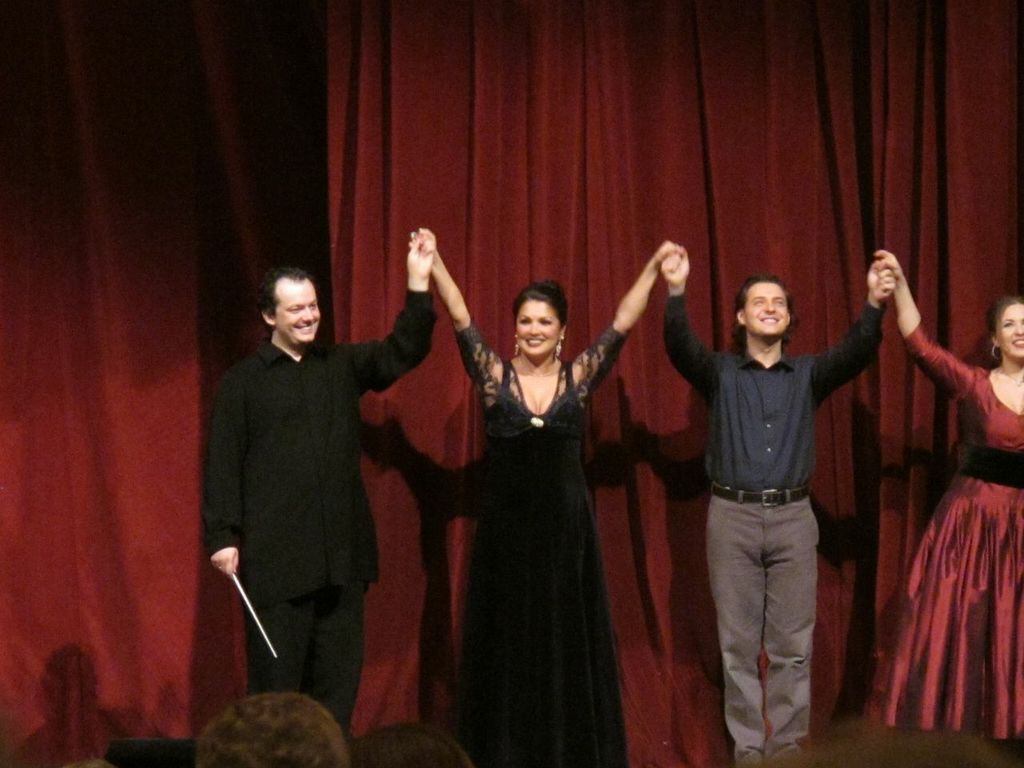
Anna Netrebko was amazing by all means and she deserved the rapturous ovations she got.
I was more than impressed by her acting and her stage presence. For the first time, I had the real Tatiana on stage.
She was really like a young girl at the beginning, shy, but passionate. A very beautiful girl, but still a too young one, that couldn’t make Onegin fall for her. Her letter scene was passionate and she conveyed all the different emotions that are written in the music, in the score. That was acting and artistry at a very high level.
When she entered the stage at the beginning of the third act, at Gremin’s arm, she looked fabulous. Her Tatiana finally became a gorgeous woman and there one could finally understand why Onegin fell for her.
She moved like a princess. She managed to portray her Tatiana as a woman now apparently sure of herself, but still a bit melancholic and who didn’t forget the young girl she was. That’s why the last scene was so heartbreaking.
It’s the first time I see a Tatiana so believable and so cleverly played.
The singing was magnificent too. The voice was powerful, but allowed nuances and soft singing when needed. The colors were incredible and she sang with sheer passion.
On the 15th, there were anyway minor faults in the singing, some high notes too sharp mainly. They didn’t distract from a gorgeous performance, but one could notice them.
On that point the 18th, Netrebko raised her game. It was incredible. From the first note she sang till the last, one could not help being hypnotized by her singing. If possible, she put more passion in her singing, which was at the same time more powerful, more precise and more gorgeous.
People (including me) became crazy at the curtain calls and screamed their love and their gratitude when she appeared.
She was visibly happy, but wanted to share it with the rest of the cast and especially Hvorostovsky, whom she pushed in front of the scene to be applauded. She is definitely a great human being, besides from being a fantastic singer.
There were many people at the stage door, many of them were pushing, screaming, taking many pictures of her with the flash near her face, but she kept calm and nice (I don’t know how she could).
She took the camera from the hands of one of these men who was trying to take a picture of her, said “this is how it must be done”, took herself a picture of them both and gave him the camera back. The crowd went wild and screamed “Bravooo ! Anna we love you ! You’re the best”…
She took time to speak with some people, to sign autographs, to pose for pictures, to have nice words about her partners, and then went away, looking really gorgeous.
These evenings were incredible. If you add that the previous evening, a very good Simon Boccanegra was performed at the Konzerthaus, and that on the 16th A-S Mutter and Y. Nezet-Seguin were at the Musikverein, for a fantastic night, you can say that Viennese people are very lucky with music.
Now I’m really looking forward the HD screening of Onegin at the MET, with Gergiev !!!!
Anne-Laure
PHOTOS
Eugene Onegin, Wiener Staatsoper, Wien 18. Apr 2013. Photo credit: Anne
Eugene Onegin, Wiener Staatsoper, Wien 18. Apr 2013. Photo credit: Anne
Eugene Onegin, Wiener Staatsoper, Wien 18. Apr 2013. Photo credit: Anne
Eugene Onegin, Wiener Staatsoper, Wien 18. Apr 2013. Photo credits: Anne-Laure/Arnaud
Eugene Onegin, Wiener Staatsoper, Wien 18. Apr 2013. Photo credits: Anne-Laure/Arnaud
Eugene Onegin, Wiener Staatsoper, Wien 18. Apr 2013. Photo credits: Anne-Laure/Arnaud
Eugene Onegin, Wiener Staatsoper, Wien 18. Apr 2013. Photo credits: Anne-Laure/Arnaud
Eugene Onegin, Wiener Staatsoper, Wien 18. Apr 2013. Photo credits: Anne-Laure/Arnaud
Eugene Onegin, Wiener Staatsoper, Wien 18. Apr 2013. Photo credits: Anne-Laure/Arnaud
Eugene Onegin, Wiener Staatsoper, Wien 18. Apr 2013. Photo credits: Anne-Laure/Arnaud
Eugene Onegin, Wiener Staatsoper, Wien 18. Apr 2013. Photo credits: Anne-Laure/Arnaud
Eugene Onegin, Wiener Staatsoper, Wien 18. Apr 2013. Photo credits: Anne-Laure/Arnaud
Eugene Onegin, Wiener Staatsoper, Wien 18. Apr 2013. Photo credits: Anne-Laure/Arnaud
Eugene Onegin, Wiener Staatsoper, Wien 18. Apr 2013. Photo credits: Anne-Laure/Arnaud
Eugene Onegin, Wiener Staatsoper, Wien 18. Apr 2013. Photo credits: Anne-Laure/Arnaud
Eugene Onegin, Wiener Staatsoper, Wien 18. Apr 2013. Photo credits: Anne-Laure/Arnaud
Eugene Onegin, Wiener Staatsoper, Wien 18. Apr 2013. Photo credits: Anne-Laure/Arnaud
Eugene Onegin, Wiener Staatsoper, Wien 18. Apr 2013. Photo credits: Anne-Laure/Arnaud
Eugene Onegin, Wiener Staatsoper, Wien 18. Apr 2013. Photo credits: Anne-Laure/Arnaud
Eugene Onegin, Wiener Staatsoper, Wien 18. Apr 2013. Photo credits: Anne-Laure/Arnaud
Eugene Onegin, Wiener Staatsoper, Wien 18. Apr 2013. Photo credits: Anne-Laure/Arnaud
Eugene Onegin, Wiener Staatsoper, Wien 18. Apr 2013. Photo credits: Anne-Laure/Arnaud
Eugene Onegin, Wiener Staatsoper, Wien 18. Apr 2013. Photo credits: Anne-Laure/Arnaud
Eugene Onegin, Wiener Staatsoper, Wien 18. Apr 2013. Photo credits: Anne-Laure/Arnaud
Eugene Onegin, Wiener Staatsoper, Wien 18. Apr 2013. Photo credits: Anne-Laure/Arnaud
Eugene Onegin, Wiener Staatsoper, Wien 18. Apr 2013. Photo credits: Anne-Laure/Arnaud
Eugene Onegin, Wiener Staatsoper, Wien 18. Apr 2013. Photo credits: Anne-Laure/Arnaud
Eugene Onegin, Wiener Staatsoper, Wien 18. Apr 2013. Photo credits: Anne-Laure/Arnaud
Eugene Onegin, Wiener Staatsoper, Wien 18. Apr 2013. Photo credits: Anne-Laure/Arnaud
Eugene Onegin, Wiener Staatsoper, Wien 18. Apr 2013. Photo credits: Anne-Laure/Arnaud
Eugene Onegin, Wiener Staatsoper, Wien 18. Apr 2013. Photo credits: Anne-Laure/Arnaud
Eugene Onegin, Wiener Staatsoper, Wien 18. Apr 2013. Photo credit: Anne
Eugene Onegin, Wiener Staatsoper, Wien 18. Apr 2013. Photo credit: Anne
Eugene Onegin, Wiener Staatsoper, Wien 18. Apr 2013. Photo credit: Anne
Eugene Onegin, Wiener Staatsoper, Wien 18. Apr 2013. Photo credit: Anne
Eugene Onegin, Wiener Staatsoper, Wien 18. Apr 2013. Photo credit: Anne
Dmitry Korchak, Eugene Onegin, Wiener Staatsoper, Wien 18. Apr 2013. Photo credit: Anne
Dmitry Korchak, Eugene Onegin, Wiener Staatsoper, Wien 18. Apr 2013. Photo credit: Anne
Anna Netrebko, Eugene Onegin, Wiener Staatsoper, Wien 18. Apr 2013. Photo credit: Anne
Dmitri Hvorostovsky, Eugene Onegin, Wiener Staatsoper, Wien 18. Apr 2013. Photo credit: Anne
Dmitri Hvorostovsky, Eugene Onegin, Wiener Staatsoper, Wien 18. Apr 2013. Photo credit: Anne
Dmitri Hvorostovsky, Eugene Onegin, Wiener Staatsoper, Wien 18. Apr 2013. Photo credit: Anne
Dmitri Hvorostovsky, Eugene Onegin, Wiener Staatsoper, Wien 18. Apr 2013. Photo credit: Anne
Anna Netrebko, Eugene Onegin, Wiener Staatsoper, Wien 18. Apr 2013. Photo credit: Anne
Anna Netrebko, Eugene Onegin, Wiener Staatsoper, Wien 18. Apr 2013. Photo credit: Anne
Anna Netrebko, Eugene Onegin, Wiener Staatsoper, Wien 18. Apr 2013. Photo credit: Anne
Anna Netrebko, Eugene Onegin, Wiener Staatsoper, Wien 18. Apr 2013. Photo credit: Anne
Anna Netrebko, Eugene Onegin, Wiener Staatsoper, Wien 18. Apr 2013. Photo credit: Anne
Anna Netrebko, Eugene Onegin, Wiener Staatsoper, Wien 18. Apr 2013. Photo credit: Anne
Anna Netrebko, Eugene Onegin, Wiener Staatsoper, Wien 18. Apr 2013. Photo credit: Anne
Anna Netrebko, Eugene Onegin, Wiener Staatsoper, Wien 18. Apr 2013. Photo credit: Anne
Anna Netrebko, Eugene Onegin, Wiener Staatsoper, Wien 18. Apr 2013. Photo credit: Anne
Anna Netrebko, Eugene Onegin, Wiener Staatsoper, Wien 18. Apr 2013. Photo credit: Anne
Anna Netrebko, soprano,
Brian Zeger, pianist
Vilar Performing Arts Center, March 25, 2013 - 6:30 p.m.
PART 1
Arditi "Il bacio"
Rimsky-Korsakov "Ne veter, veya s visoti" (op. 43, no. 2)
Rimsky-Korsakov "Plenivsis rozoy, solovey" (op. 2, no. 2)
Tchaikovsky "Skazi, o cyom v teni vetney" (op. 57, no. 1)
Dvorak "Lullaby"
Rakhmaninov "Ne poy krasavitza"
Strauss "Cacilie"
Intermission
PART 2
Puccini "In quelle trine morbide: (Manon Lescaut)
Giordano "La mama morta" (Andrea Chenier)
Bioto "L'altra notte" (Mefistofele)
Puccini "Sola, perduta abbandonata" (Manon Lescaut)
Cilea "Ecco! Io son l'umile ancella" (Adriana Lecouvreur)
Encore
Puccini "O mio babbino caro" (Gianni Schicchi)
REVIEW
By Robert
Anna opened the concert wearing a floor-length purple skirt, form-fitting at the hips and flaring below, with a purple and turquoise top above a short gold dirndl. Very festive! When she walked on stage she was greeted with a standing ovation from an audience two-thirds of which, as revealed by a show hands requested by the master of ceremonies, had travelled to this remote ski resort village specifically to hear Anna sing.
Part 1 of the program was devoted to art songs, before each of which Anna spoke briefly, setting the scene. For these she moved freely about the stage, subtly enacting the mini drama of each song, but also turning our attention to her accompaniest, her back to the audience or her hand attentively on his shoulder, during extended piano passages.
Having heard Anna live in more than two dozen opera performances since 1999, watched all of her Met HD performances, and spent untold hours with her CDs and DVDs, the voice was all that we had come to expect: gorgeously full with a cornucopia of colors, radiant highs, resonant lows and meltingly beautiful legato technique; evenly produced from top to bottom with no register breaks; and with the ample dynamic range and messa di voce technique needed to support the wide spectrum of drama and mood that these songs demand. And, unlike in operas or in her televised concerts with other singers, this was all Anna all evening! Before beginning to sing she commented wryly that she had been told that if she sang badly she could blame it on the altitude (8100 feet). But, of course, she sang magnificantly. The only audible effect of diminished oxygen was the occasional extra breath (e.g., in the long legato line, "napominayut mne one" in the final verse of "Ne poy krasavitza"), probably noticeable only to those familiar with her recordings of these songs.
After the intermission Anna appeared in an elegant royal blue floor-length dress. She explained that the second half of the program would consist of opera arias and that for these she would be moving less around the stage. Even so, with a thespian's grace and economy of gesture she embodied each successive character and gave visual resonance to the varied, often intense drama of the music. The arias all came from operas that Anna has yet to perform on stage (nor, to our knowledge, has she previously sung them in concert) and as such were an enticing harbinger both of new pleasures awaiting us in the future and of the big dramatic roles that Anna has said she was chomping at the bit to sing as a voice student in Leningrad (as it was then). In the final aria, Adriana, a famous (historical) actrice, is telling admirers that her abilities are merely the gift of the Muses, she herself simply the servant of the playwright. Anna introduced the aria as one especially close to her heart; for us its message reflected the public personna that Anna herself so consistently projects.




,1.jpg)


,1.jpg)


.JPG)


